Decoding the Visual Language of Modern Career Search
In the digital age, the journey to finding employment has shifted dramatically from physical newspaper classifieds to complex online ecosystems. Amidst this transition, a specific visual language has emerged to guide, represent, and simplify the process: job hunting collection elements icons. These simple yet powerful graphic symbols serve as the universal shorthand for the modern career seeker. Whether you are a graphic designer creating a recruitment portal, a job seeker navigating a new platform, or a business owner refining your hiring strategy, understanding the significance of these linear pictograms is essential.
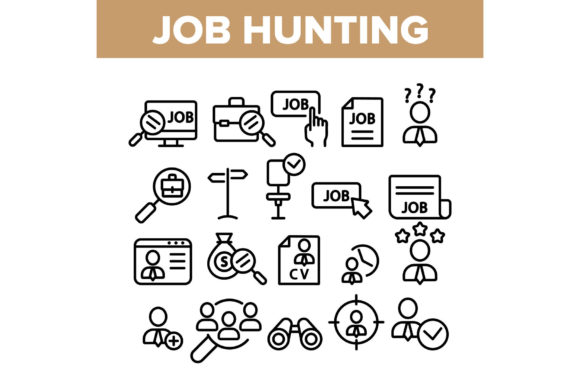
This article explores the purpose, design philosophy, and practical application of job hunting icon sets, specifically focusing on the popular magnifier with suitcase and computer motifs found in vector thin line collections. We will delve into why these monochrome contour illustrations have become indispensable tools in business, technology, and daily professional life.
The Evolution of Recruitment Visuals
Historically, finding a job was a tactile experience involving physical resumes and face-to-face interactions. Today, the process is almost entirely digital. This shift necessitated a new way to communicate complex actions quickly and clearly on screens of all sizes. Enter the icon. Icons act as cognitive shortcuts, allowing users to identify functions like "search," "apply," or "profile" without reading lengthy text descriptions.
A comprehensive Job Hunting Collection Elements Icons Set typically includes a variety of symbols that map out the entire lifecycle of employment. From the initial search phase to the final interview, each stage is represented by a distinct image. The popularity of vector thin line styles lies in their versatility. Unlike heavy, filled graphics, thin lines offer a modern, clean aesthetic that fits seamlessly into minimalist web designs and mobile applications. They are lightweight, scalable, and retain clarity whether viewed on a smartwatch or a large desktop monitor.
Key Symbols and Their Semantic Meaning
To truly understand the utility of these graphics, one must look at the specific elements that make up a standard collection. Each icon carries a specific semantic weight that helps users navigate the often stressful process of job hunting.
- The Magnifier: Perhaps the most ubiquitous symbol in any search interface. In the context of job hunting, the magnifier represents discovery and scrutiny. It signifies the active phase where a candidate searches for opportunities or an employer scans through databases of talent.
- The Suitcase: A classic metaphor for professional life. It represents the worker, the career path, and the portability of skills. When paired with other elements, it grounds the abstract concept of "employment" in a tangible object.
- The Computer: This element highlights the medium of modern work. It reminds us that today's economy is digital. A computer icon in a job hunt set often points to remote work opportunities, tech-based roles, or the online application process itself.
- The Businessman/Professional: Humanizing the data. While algorithms sort resumes, the ultimate goal is human connection. Icons depicting a silhouette of a professional add a personal touch to corporate interfaces.
When these elements are combined—such as a magnifier hovering over a suitcase or a businessman sitting at a computer—they create a narrative. They tell a story of active searching, professional readiness, and digital engagement. This storytelling capability is what makes a high-quality icon set so valuable for user experience (UX) design.
The Power of Monochrome Contour Illustrations
You may notice that many premium icon sets, including those available in JPG and EPS formats, utilize a monochrome contour style. Why is this specific artistic choice so prevalent in the business world? The answer lies in flexibility and focus.
Monochrome (single-color) designs ensure that the icons do not clash with a brand's existing color palette. A recruitment website might use blue for trust, while a creative agency might prefer orange for energy. By providing icons in black or dark gray outlines, designers allow the end-user to recolor the vectors to match their specific branding guidelines instantly. This adaptability is crucial for maintaining visual consistency across a website or app.
Furthermore, contour illustrations (line art) reduce visual noise. In a dashboard filled with charts, graphs, and text blocks, a solid, filled icon might feel heavy and distracting. Thin lines provide the necessary information without overwhelming the viewer. This aligns with the principle of "less is more," helping users focus on the content rather than the decoration.
Practical Applications in Modern Business
The utility of a Job Hunting Collection Elements Icons Set extends far beyond simple decoration. These assets are foundational building blocks for various digital products and services.
- Recruitment Platforms: Websites like LinkedIn, Indeed, or niche job boards rely heavily on these icons to categorize jobs, indicate status (e.g., "Applied," "Interviewing"), and guide navigation menus.
- Corporate Career Pages: Companies use these visuals to make their "Careers" section inviting and easy to navigate. A friendly icon of a handshake or a briefcase can make a large corporation feel more approachable to potential applicants.
- Presentation Decks: HR professionals and career coaches often use these vectors in PowerPoint or Keynote presentations to illustrate trends in the labor market, explain the hiring funnel, or provide tips on resume building.
- Infographics and Content Marketing: Bloggers and marketers use these icons to break up text and visualize statistics about unemployment rates, top hiring industries, or salary trends.
For developers and designers, having access to these files in EPS (Encapsulated PostScript) format is particularly important. EPS is a vector format, meaning the image is defined by mathematical paths rather than pixels. This allows the icon to be scaled up to the size of a billboard or down to the size of a favicon without losing any quality or becoming pixelated. While JPG files are useful for quick previews or web usage where vector support is limited, the EPS file is the master source for professional editing.
Clarifying Common Misunderstandings
Despite their simplicity, there are occasional misconceptions regarding the use of stock iconography. One common assumption is that all "job hunting" icons are generic and lack personality. However, a well-curated linear pictogram set often includes unique variations that convey specific nuances. For instance, the difference between a "freelance" icon and a "corporate" icon might be subtle—a laptop with a coffee cup versus a laptop in an office setting—but these details matter in conveying the right message.
Another misunderstanding involves the technical requirements. Some beginners assume that downloading a JPG is sufficient for all purposes. While JPGs are convenient, they are raster images. If you attempt to enlarge a small JPG icon for a print brochure, it will become blurry. For professional results, especially in print or high-resolution displays, always prioritize the vector (EPS) version when available.
Building a Broader Understanding of Digital Literacy
Ultimately, engaging with these visual tools helps build a broader understanding of digital literacy. In a world where communication is increasingly visual, the ability to interpret and utilize symbols like the magnifier, suitcase, and computer is a soft skill in itself. It represents an understanding of how information is organized and how systems function.
For the job seeker, recognizing these icons quickly can speed up the application process, reducing anxiety and increasing efficiency. For the creator, mastering the use of these elements allows for the construction of intuitive, user-friendly interfaces that respect the user's time and cognitive load.
In conclusion, the Job Hunting Collection Elements Icons are more than just decorative clip art. They are the signposts of the modern economic landscape. Through their clean lines, adaptable formats, and clear symbolism, they bridge the gap between complex hiring processes and human understanding. Whether you are designing the next great job board or simply updating your resume portfolio, leveraging these monochrome contour illustrations ensures your message is delivered with clarity, professionalism, and impact.