Elevating Brand Identity Through Versatile Digital Design Assets
In the contemporary landscape of digital commerce and creative entrepreneurship, the distinction between a fleeting trend and a sustainable brand asset often lies in the quality and versatility of the underlying design files. Professionals, marketers, and creators are increasingly recognizing that the foundation of a successful product line—whether for web presence, print media, or physical merchandise—is not merely the visual concept, but the technical robustness of the file formats used to execute it. A prime example of this shift toward high-quality, multi-format utility is found in designs such as Yes I Really Do Need All These Cats. While the subject matter appeals to the enduring popularity of feline-themed content, the true value proposition for the modern entrepreneur lies in the comprehensive suite of file types and the adaptability they offer across diverse production workflows.
The Convergence of Humor and Market Demand
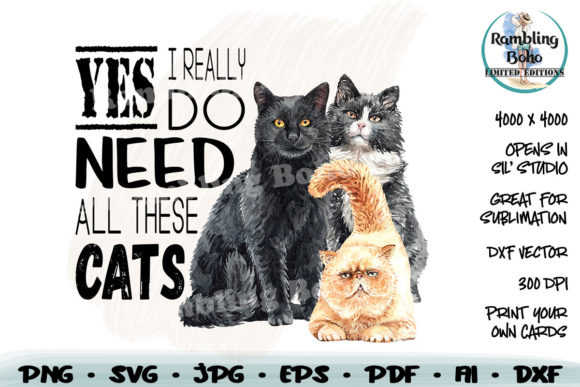
The phrase Yes I Really Do Need All These Cats resonates deeply within current consumer culture, tapping into a broader lifestyle trend where pet ownership is viewed not just as a responsibility, but as a core component of personal identity. For marketers and freelancers, leveraging this sentiment requires more than a simple text overlay; it demands a design that balances rich colors with simple lines to ensure legibility across various mediums. This specific type of high-quality digital design serves as a bridge between personal expression and commercial viability. When a design is executed with precision, it transcends its immediate context, becoming a viable asset for sublimation on cards, mugs, towels, tumblers, and t-shirts.
The market's attention to such assets is driven by a changing preference for authenticity and niche specificity. Consumers are moving away from generic, mass-produced imagery in favor of designs that speak directly to their unique passions. A design that confidently declares a love for multiple cats does exactly this. However, the ability to capitalize on this demand relies heavily on the creator's access to files that maintain integrity regardless of the application. This is where the technical specifications of the asset become as critical as the artistic vision.
Technical Versatility as a Business Imperative
In a professional workflow, the limitation of a single file format can create bottlenecks that stifle scalability. The modern creator operates in an omnichannel environment where a single design must perform equally well on a website favicon, a large-format banner, and a laser-cut sticker. The inclusion of multiple formats—PNG, JPG, SVG, EPS, PDF, AI, and DXF—in a single download package represents a significant advancement in workflow efficiency. This approach eliminates the need for conversion tools that often degrade image quality or alter vector paths, ensuring that the original vision remains intact from concept to final product.
Consider the SVG format, which opens seamlessly in Silhouette Studio. For entrepreneurs utilizing cutting machines for iron-ons, stickers, and waterslides, this vector capability is indispensable. Unlike raster images that pixelate when enlarged, SVG files allow for infinite scalability without loss of resolution. This means a design intended for a small mug can be effortlessly adapted for a large tote bag or a storefront window display. Similarly, the DXF file, functioning as a non-color vector path, is engineered specifically for cutting machines, laser systems, and CAD software. This level of compatibility ensures that the design is not locked into a single production method, granting the user the freedom to pivot strategies based on market feedback or inventory needs.
Optimizing for Print and Sublimation
For those focused on physical products, the fidelity of the print output is paramount. The availability of PNG formats with transparent backgrounds, alongside high-quality JPG files, addresses the nuanced requirements of different printing technologies. Sublimation, a process widely used for creating vibrant, long-lasting images on ceramics and textiles, demands high-resolution inputs to prevent blurring or color banding. With graphics rendered at 4000px x 4000px and 300dpi, approximating a physical size of 13″ x 13″, these assets provide the necessary density for crisp, professional results.
Furthermore, the inclusion of EPS and AI formats, even when flattened to preserve the integrity of design elements, offers a layer of security and compatibility for professional printing houses. These formats ensure that complex layer structures or font dependencies do not cause errors during the pre-press stage. By providing a PDF format specifically optimized for printing, the asset caters to traditional offset printing workflows as well, broadening the potential distribution channels for the creator. This comprehensive approach to file delivery acknowledges that the "best" format is entirely dependent on the end-use case, and therefore, providing all options is the only logical strategy for a high-value digital product.
Adapting to Evolving Creative Workflows
The relevance of such multifaceted digital assets extends beyond immediate production capabilities; it reflects a broader shift in how creatives manage their intellectual property and operational overhead. In the past, a designer might have needed to purchase separate licenses or create distinct versions of a file for web use, cuttable vinyl, and high-res print. Today, the expectation is for a unified, ready-to-deploy solution. This consolidation reduces the time-to-market for new products, allowing freelancers and small business owners to test ideas rapidly and iterate based on real-world data.
Moreover, the ability to alter sizes and open files in various programs empowers users to customize the asset to fit specific brand guidelines. Whether a marketer needs to integrate the So. Many. Cats. motif into a larger campaign collage or a manufacturer needs to adjust the scale for a specific tumbler curvature, the flexibility of vector-based and high-resolution raster files facilitates these adjustments without compromising quality. This adaptability is crucial in an era where personalization is a key driver of consumer engagement.
The Economic Impact of High-Quality Downloads
It is important to note that these assets are purely digital downloads; no physical products are sent. This model aligns with the growing economy of digital goods, where the value is derived from the utility and license of the file rather than the cost of materials and shipping. For the buyer, this意味着 instant access and the elimination of logistical delays. For the seller, it enables a scalable business model where inventory costs are negligible, and the focus can remain on design innovation and marketing strategy.
However, the digital nature of the product places a higher premium on the quality of the deliverables. Since the customer cannot physically inspect the item before purchase, the detailed specification of file types, resolutions, and compatibility becomes the primary indicator of value. Statements regarding color variation due to screen settings and printing methods serve not just as legal disclaimers, but as educational touchpoints that manage expectations and reinforce the professional nature of the transaction.
Future-Proofing Creative Ventures
As technology continues to evolve, the tools used for creation and manufacturing will undoubtedly change. Laser cutters will become more precise, sublimation printers will offer wider color gamuts, and web standards will demand even higher fidelity. Yet, the fundamental requirement for clean, versatile, and well-structured design files will remain constant. Investing in assets like Yes I Really Do Need All These Cats is an investment in future-proofing one's creative portfolio. By securing files that are compatible with current industry standards—from Silhouette Studio to CAD systems—creators ensure that their work remains relevant and usable regardless of technological shifts.
In conclusion, the success of a design in today's market is not solely determined by its aesthetic appeal but by its functional resilience. The integration of rich colors, simple lines, and a comprehensive array of file formats creates a powerful tool for professionals across industries. Whether utilized for a niche Etsy shop, a corporate branding campaign, or a personal DIY project, the versatility of these digital assets empowers users to bring their visions to life with precision and confidence. As the boundaries between digital and physical continue to blur, the demand for such high-quality, adaptable resources will only continue to grow, making them an essential component of the modern creator's toolkit.