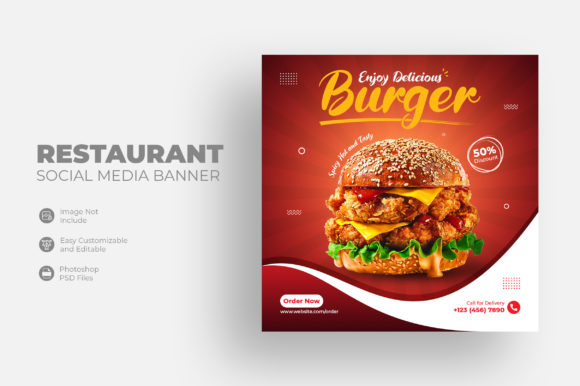
Maximizing Visual Impact with a Professional Restaurant Social Media Banner Template
In the hyper-competitive landscape of the modern culinary industry, visual presentation is often the deciding factor between a scrolling user and a seated customer. Digital storefronts have replaced physical signage for millions of consumers who discover dining options through Instagram, Facebook, and Twitter. To capture this attention, food establishments require high-quality, consistent, and engaging graphics. This is where utilizing a specialized Restaurant Social Media Banner Template becomes an essential component of a marketing strategy. These digital assets serve as the foundation for brand identity online, allowing businesses to communicate their atmosphere, menu highlights, and special offers without the need for expensive graphic design retainers.
The shift toward visual-first social media platforms means that static text updates no longer suffice. Users expect immersive imagery that evokes taste and ambiance instantly. A well-crafted banner template provides the structural integrity needed to maintain professionalism while offering the flexibility to adapt to daily promotions. Whether it is a fine dining establishment showcasing a seasonal tasting menu or a casual cafe promoting a weekend brunch special, the underlying design framework ensures that every post aligns with the brand's aesthetic standards.
The Strategic Value of Editable Design Assets
For restaurant owners and marketing managers, time is a scarce resource. The ability to produce high-quality content quickly is paramount. A Restaurant Social Media Banner Template addresses this challenge by providing a pre-designed layout where the heavy lifting of composition, typography pairing, and color theory has already been executed by professional designers. These templates are typically delivered in PSD (Photoshop Document) format, which allows for granular control over every element of the design.
The primary advantage of using such templates lies in their editability. Unlike rigid online generators that limit customization, a PSD file enables users to manipulate layers, adjust blending modes, and refine details to match specific campaign needs. When a template features easy customizable and editable characteristics, it empowers non-designers to swap out placeholder images with actual photography of their dishes, change text to reflect current pricing or event dates, and modify colors to suit seasonal themes. This level of control ensures that the final output feels authentic to the restaurant rather than generic.
Furthermore, these templates are designed with technical precision. High-resolution files ensure that graphics look crisp on retina displays and large monitors, preventing the pixelation that can undermine a brand's perceived quality. By starting with a robust template, businesses avoid the common pitfalls of amateur design, such as poor contrast, cluttered layouts, or inconsistent font usage.
Technical Specifications and Quality Standards
Understanding the technical underpinnings of a design template is crucial for maximizing its utility. A premium Restaurant Social Media Banner Template is not merely a collection of shapes; it is a engineered file built to industry standards. Key specifications often include an RGB Color Mode, which is optimized for digital screens. Unlike CMYK, which is used for print, RGB ensures that the vibrant reds of a tomato sauce or the fresh greens of a salad appear vivid and true-to-life on smartphones and tablets.
Resolution is another critical factor. While some templates advertise 72 dpi for web use, high-end templates often provide files at 300 DPI Resolution. Although 72 dpi is traditionally associated with screen display, having a 300 dpi source file offers significant advantages. It provides a higher density of pixels, allowing for greater flexibility if the image needs to be cropped, zoomed, or repurposed for high-definition displays without losing clarity. The standard dimension for these social assets is typically 1080×1080 px, the universal square format required by Instagram feeds and Facebook posts. This square ratio dominates mobile screens, making it the most effective shape for capturing attention in a scrollable feed.
Compatibility is also a major consideration. Most professional templates are created using Adobe Photoshop CC, the industry-standard software for raster graphics. This ensures that users with access to Creative Cloud can open, edit, and save the files without compatibility errors. It is important to note that while the template structure is included, the photo is not included. This separation allows the restaurant to insert its own proprietary imagery, which is vital for maintaining authenticity. Stock photos can sometimes feel impersonal; using real photos of the restaurant's actual plates and interior builds trust with potential diners.
Implementing Templates into a Content Workflow
Integrating a Restaurant Social Media Banner Template into a daily workflow requires a systematic approach. The process begins with asset collection. Before opening the PSD file, a marketing team should gather high-resolution photographs of the dishes or events they wish to promote. These images should be well-lit and composed, as the template can only enhance good photography, not fix bad lighting.
Once the images are ready, the user opens the template in Adobe Photoshop. The layer panel will reveal organized groups, often labeled "Image Placeholder," "Headline Text," "Subtext," and "Background." The workflow involves double-clicking the smart object layer designated for the image, pasting the new photo, saving the smart object, and watching the main canvas update automatically. This non-destructive editing method preserves the original design ratios and masks.
Text customization follows. Users can select the text layers to update the message. For example, changing "Summer Special" to "Winter Warmers" or updating a date from "July 1st" to "August 15th." Because the template uses professional typography settings, the kerning, leading, and font weights are already optimized for readability. However, users should remain mindful of character counts; overcrowding a banner with too much text can dilute the message. The goal is instant comprehension.
Color adjustments are the final step in the customization process. If a restaurant wants to align a post with a specific holiday, such as using green and red for Christmas or orange and black for Halloween, the hue/saturation adjustment layers within the template allow for quick global color shifts. This adaptability makes a single Restaurant Social Media Banner Template usable year-round for countless different campaigns.
Diverse Use Cases for Culinary Marketing
The versatility of these templates extends across various marketing objectives. One common application is the announcement of new menu items. A visually striking banner can highlight a signature dish, drawing the eye immediately to the food while providing space for a brief, appetizing description. Another frequent use case is event promotion. Whether it is a live music night, a wine tasting evening, or a chef's table experience, the template provides a structured space to display the event details clearly against an atmospheric background.
Seasonal promotions also benefit greatly from templated designs. Restaurants often run limited-time offers during holidays or changes in seasons. Having a library of editable banners allows a business to pivot quickly, launching a "Valentine's Day Set Menu" graphic hours after the decision is made. Additionally, these templates are effective for user-generated content campaigns. A restaurant can create a banner frame that encourages customers to tag the establishment in their photos, fostering community engagement.
Beyond individual posts, consistency is key. By using variations of the same Restaurant Social Media Banner Template, a brand creates a cohesive grid on their social media profile. When a potential customer visits the page, they see a unified visual language that reinforces brand recognition. This professionalism signals to the consumer that the restaurant cares about details, a trait that often translates to expectations of quality in the kitchen.
Considerations for Effective Design Execution
While templates provide a strong foundation, the end result depends on how they are utilized. One common mistake is ignoring the hierarchy of information. In a Restaurant Social Media Banner Template, the most important element—usually the food image or the main offer—should dominate the visual space. Secondary information, such as terms and conditions or website URLs, should be smaller but still legible. Users must resist the urge to fill every empty pixel; negative space is a powerful design tool that guides the viewer's eye.
Another consideration is the accuracy of the representation. Since the photo is not included in the download, the responsibility falls on the user to ensure their images match the mood of the template. A moody, dark-themed template might not suit a bright, airy breakfast spot unless the lighting in the photograph is adjusted accordingly. Color grading the photos to match the template's palette can create a seamless integration between the design elements and the photography.
Accessibility should also be kept in mind. Text placed over images must have sufficient contrast to be readable for all users, including those with visual impairments. Many templates include overlay layers or gradient masks specifically designed to improve text legibility against complex backgrounds. Utilizing these features ensures that the message reaches the widest possible audience.
The Role of High-Resolution Assets in Brand Perception
In an era where smartphone cameras boast incredible sensors, low-resolution graphics stand out negatively. A pixelated logo or a blurry food image can subconsciously signal negligence. By leveraging a template designed with 300 DPI Resolution capabilities, restaurants ensure that their digital presence matches the quality of their physical service. Even though social media platforms compress images upon upload, starting with the highest possible quality source file ensures that the compressed version retains as much detail and sharpness as possible.
The 1080×1080 px Dimension is specifically chosen because it maximizes the screen real estate on mobile devices. Vertical images take up more space, but square images offer a balanced view that works well in both feed and grid views. This standardization simplifies the content creation process, as marketers do not need to redesign layouts for different aspect ratios for every single post.
Ultimately, the adoption of a professional Restaurant Social Media Banner Template is an investment in efficiency and brand equity. It bridges the gap between high-end agency work and DIY marketing, providing small and medium-sized enterprises with the tools to compete visually with larger chains. By understanding the features, technical requirements, and strategic applications of these templates, food businesses can craft compelling narratives that resonate with diners, drive engagement, and ultimately increase foot traffic. The combination of RGB Color Mode vibrancy, layered editability, and professional composition makes these templates an indispensable asset in the digital toolkit of any modern restaurateur.