Integrating Balloons Watercolor Design Elements into Professional Creative Workflows
In the landscape of modern digital design, the demand for authentic, handcrafted aesthetics has never been higher. Clients and audiences alike are drawn to visuals that convey warmth and personality, moving away from sterile, vector-perfect graphics toward textures that feel human. This is where Balloons Watercolor Design Elements serve as a critical asset for creators who need to balance artistic flair with production efficiency. This specific graphic set, featuring handpainted watercolor illustrations complete with paint strokes and splats, is not merely a collection of images; it is a functional toolkit designed to streamline the creative process across various industries.
Understanding how to effectively deploy these assets requires a shift in perspective. Instead of viewing them as static clipart, professionals should treat them as modular components within a broader design system. Whether you are a marketer launching a new campaign, an educator creating engaging materials, or a small business owner handling your own branding, the integration of high-quality watercolor elements can significantly elevate the perceived value of your output while reducing the time spent on custom illustration.
The Strategic Value of Pre-Made Watercolor Assets
The primary advantage of utilizing a curated set like this lies in the optimization of the planning and execution phases of a project. For freelancers and agencies operating under tight deadlines, the decision to commission custom watercolor paintings for every project is often financially and temporally unfeasible. Custom illustration involves multiple rounds of sketches, color approvals, and digitization. By contrast, incorporating a Balloons Watercolor Design Elements pack allows you to bypass the creation phase and move immediately to composition and layout.
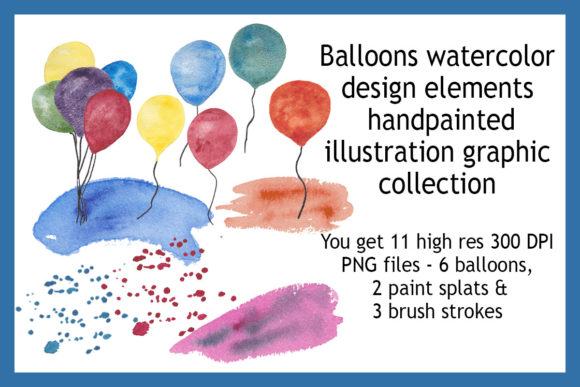
This set includes six distinct balloon designs, two paint splats, and three brush strokes, totaling eleven high-resolution files. While the count may seem modest, the utility of these elements expands exponentially when viewed through the lens of workflow integration. Each file is rendered at 300 DPI on a transparent background, ensuring compatibility with both print and digital mediums. This technical specification is crucial for quality control. It means a designer can place a balloon on a wedding invitation destined for professional offset printing without worrying about pixelation, or use the same asset on a website header where crisp edges are paramount.
Pre-Production: Planning and Asset Organization
Effective use of these design elements begins before the first pixel is placed in a layout program. In the preparation stage, successful creators organize their digital libraries to ensure rapid retrieval. When a project brief calls for a celebratory or whimsical tone—common in announcements, birthdays, or baby showers—having a dedicated folder for watercolor assets prevents the "scrolling fatigue" that often slows down designers.
Consider the workflow of a stationery designer preparing for a holiday rush. By pre-sorting assets like the paint splats and brush strokes alongside the balloons, they create a ready-to-use palette. This organization supports consistency; if a brand guideline suggests a hand-painted look, pulling from a single cohesive set ensures that the texture of the balloon matches the texture of the background accents. Mixing assets from disparate sources often results in visual dissonance, where lighting directions or paper grain textures clash. A unified set eliminates this risk, maintaining a professional standard throughout the project lifecycle.
Implementation Across Diverse Mediums
The versatility of handpainted watercolor illustrations allows them to fit seamlessly into various stages of a project, whether it is the initial concepting phase or the final polish. The application of these elements differs significantly depending on the medium, requiring an adaptive approach to layering and composition.
Paper Crafts and Scrapbooking
For hobbyists and professional paper crafters, the tactile quality of watercolor is essential. When used in scrapbooking, these PNG files can be printed on high-quality cardstock or specialty photo paper. The transparent background ensures that no unsightly white boxes appear around the balloons when cut out or adhered to textured backgrounds. In this context, the paint splats and brush strokes serve as excellent framing devices. They can be used to anchor photos or to create visual pathways that guide the viewer's eye across a page. The 300 DPI resolution guarantees that even when scaled down for intricate die-cuts, the details of the watercolor wash remain sharp and defined.
Web Design and Digital Marketing
In the digital realm, the focus shifts to load times and scalability, though the aesthetic goal remains the same: adding humanity to the interface. Web designers can utilize the Balloons Watercolor Design Elements to break up rigid grid layouts. A cluster of balloons floating near a call-to-action button can soften the user experience, making a landing page feel more inviting and less corporate. Because the files are PNGs with transparency, they integrate cleanly into CSS backgrounds or HTML structures without requiring complex masking in code. Marketers can also leverage these assets for social media graphics. A simple announcement post gains immediate visual interest when accented with a hand-painted brush stroke behind the text, distinguishing the brand from competitors using generic stock vectors.
Invitations and Event Announcements
Perhaps the most natural fit for this graphic set is in the realm of celebrations. Event planners and independent designers often face the challenge of creating unique invitations for clients with specific themes. The watercolor balloons provide an instant thematic foundation. By layering the balloon elements with typography, a designer can create a bespoke look in minutes. The inclusion of paint splats adds a dynamic energy, suggesting movement and festivity. This is particularly effective for children's parties or casual gatherings where a formal, rigid design would feel out of place. The ability to manipulate opacity in software like Adobe Photoshop or Illustrator allows for subtle blending, making the digital art mimic the behavior of real wet-on-wet watercolor techniques.
Workflow Integration and Technical Compatibility
To maximize the return on investment for these design assets, one must understand how they interact with standard design software and workflows. The universal nature of the PNG format ensures compatibility across the industry-standard suite of tools, including Adobe Photoshop, Illustrator, Canva, Procreate, and Affinity Designer. This interoperability is vital for teams where different members may use different platforms.
For instance, a marketing team might have a graphic designer working in Photoshop to create the master banner, while a social media manager uses Canva to adapt that banner for Instagram stories. Since the Balloons Watercolor Design Elements are provided as high-res PNGs, the social media manager can drag and drop the assets directly into their templates without losing quality or needing to remove backgrounds manually. This seamless handoff reduces friction in the production pipeline and minimizes the potential for errors.
Furthermore, the separation of elements (balloons vs. splats vs. strokes) offers granular control during the editing process. A user is not forced to accept a pre-composed scene. Instead, they can deconstruct the possibilities. One might choose to use only the brush strokes as dividers in a newsletter, saving the balloons for a future holiday campaign. This modularity extends the lifespan of the asset pack, allowing it to serve multiple projects over months or even years.
Maintaining Quality and Consistency
While ease of use is a major benefit, maintaining a high standard of output is equally important. When integrating hand-painted elements into a professional workflow, attention must be paid to color management and scaling. Although watercolor is inherently organic, inconsistent application can make a design look sloppy rather than artistic.
Professionals should establish internal guidelines for how these elements are used. For example, decide on a standard opacity level for the paint splats to ensure they act as subtle textures rather than distracting noise. Ensure that the scale of the balloons relates logically to other elements on the page; a balloon that is too large can overwhelm delicate typography, while one that is too small may lose its textural detail. Regular quality checks during the proofing stage are essential. Verify that the transparent edges of the PNGs do not show halos against colored backgrounds, a common issue when low-quality assets are upscaled. With 300 DPI source files, this should not be an issue provided the assets are not stretched beyond their reasonable limits.
Long-Term Utility and Adaptability
The true measure of a design resource is its longevity. Trends in graphic design shift rapidly, but the appeal of traditional media like watercolor tends to endure. The Balloons Watercolor Design Elements are styled in a classic manner that avoids overly trendy color palettes or fads, ensuring they remain relevant for future projects. As a creator builds their portfolio, these assets can be recolored or adjusted to fit evolving brand identities.
Moreover, these elements encourage experimentation. A blogger might use the paint strokes to highlight key quotes in an article, while an educator could use the balloons to mark sections in a worksheet. The potential for repurposing is vast. By treating these eleven files as a foundational kit, users can develop a signature style that incorporates the charm of hand-painted art with the precision of digital layout. This hybrid approach satisfies the modern consumer's desire for authenticity while meeting the practical demands of speed and consistency required in today's fast-paced creative economy.
Ultimately, the successful adoption of Balloons Watercolor Design Elements hinges on viewing them not just as pictures, but as strategic tools. They bridge the gap between the time-consuming nature of traditional art and the immediate needs of digital production. By organizing these assets effectively, understanding their technical specifications, and applying them with intentionality across print and web mediums, professionals can enhance their creative output, streamline their workflows, and deliver visually compelling results that resonate with their audience.