Mastering Trust: How Flat Vector Customer Review Illustrations Transform Landing Page Design
In the digital landscape, trust is the currency that drives conversion. When a potential customer lands on your website, they are often skeptical. They do not know your brand, they have not touched your product, and they are weighing their options against competitors. This is where the concept of customer reviews becomes paramount. However, simply listing text testimonials is no longer enough to capture attention in an era of short attention spans. To truly engage users, modern web design leverages the power of visual storytelling through flat vector illustrations. These graphics, depicting people giving five-star ratings and offering positive feedback, serve as a bridge between raw data and emotional connection, significantly enhancing both customer service perception and overall user experience.
The Psychology of Social Proof in Web Design
Before diving into the technical aspects of illustration, it is essential to understand why customer reviews are so critical. This phenomenon is known as social proof. Humans are inherently social creatures; when we are uncertain about a decision, we look to others for guidance. In a physical store, you might see a long line or hear someone recommend a product. Online, that validation comes in the form of star ratings, written testimonials, and case studies.
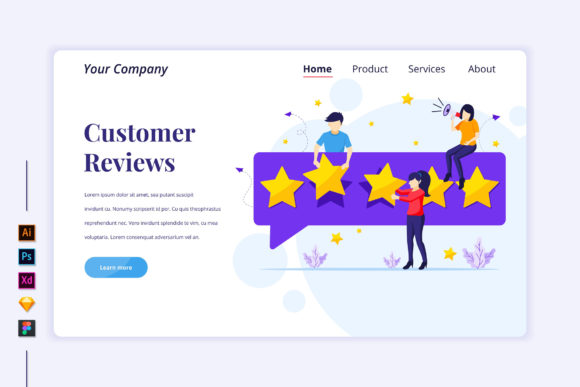
Integrating these elements into a landing page design is not just about decoration; it is a strategic move to reduce friction in the buyer's journey. When a visitor sees a graphic of a happy customer awarding five stars, their brain processes this information faster than reading a paragraph of text. It signals safety, quality, and satisfaction. By utilizing high-quality visuals to represent this feedback, businesses can instantly communicate reliability, making the abstract concept of "good reputation" tangible and visible.
Why Flat Vector Illustration is the Superior Choice
Not all images are created equal. While photographs of real people can be effective, they sometimes feel staged or may not match the specific demographic of your diverse audience. This is where flat vector illustration shines. Flat design is a minimalist style that uses simple shapes, bright colors, and two-dimensional elements to create clean and modern imagery. When applied to customer review concepts, it offers several distinct advantages:
- Universality: Vector characters are stylized enough to represent anyone, allowing users from various backgrounds to project themselves into the scenario.
- Clarity: The removal of unnecessary details (like complex textures or shadows) ensures the focus remains on the action: the act of reviewing and rating.
- Brand Consistency: Unlike stock photos which have fixed color palettes, vector illustrations can be easily edited to match your brand's exact hex codes, ensuring a seamless visual identity.
Furthermore, the technical nature of vector graphics means that every element is mathematically defined rather than pixel-based. This leads us to a crucial benefit for web designers: scalability.
The Technical Advantage: 100% Vector and Fully Editable
One of the most frustrating aspects of web design is dealing with low-resolution images that become blurry when stretched. A standard JPG or PNG file has a fixed resolution. If you try to use a small icon as a large hero image, it will pixelate, looking unprofessional and damaging credibility. In contrast, a 100% vector design template solves this problem entirely.
Because the elements are built using paths and anchor points rather than a grid of pixels, they can be resized to any dimension without losing quality. Whether you need a tiny icon for a mobile navigation bar or a massive banner for a desktop hero section, the lines remain crisp and the colors vibrant. This flexibility is vital for responsive design, where content must adapt fluidly to smartphones, tablets, and large monitors.
Moreover, professional design templates, such as those offered by creators like agnyhasyastudio, provide fully editable source files. This means you are not stuck with a static image. You can change the skin tone of the characters, adjust the color of the stars, or modify the text within the speech bubbles to better reflect your specific customer testimonials. This level of customization ensures that the illustration feels native to your site rather than a generic add-on.
Optimizing User Experience (UX) Through Visual Hierarchy
User Experience (UX) is about how a person feels when interacting with a system. A cluttered or confusing landing page increases bounce rates. Flat vector illustrations help organize information through visual hierarchy. By placing a prominent illustration of a five-star review near a "Call to Action" button, you guide the user's eye naturally toward the conversion point.
Consider the flow of a typical landing page. The user arrives, reads the headline, and immediately looks for validation. An infographic-style illustration showing a progression of happy customers creates a narrative flow. It tells a story: "Others used this, they loved it (five stars), and now it is your turn." This narrative structure reduces cognitive load, making it easier for the user to understand the value proposition quickly.
Additionally, these graphics play a significant role in customer service perception. Even before a user contacts support, seeing friendly, approachable characters giving positive feedback suggests that the company values its community. It humanizes the brand, suggesting that behind the software or product, there are real people dedicated to satisfaction.
Versatility Across Digital Platforms
The utility of a well-crafted customer review illustration extends far beyond a single landing page. Because these assets are provided in a multitude of formats, they fit seamlessly into various stages of the marketing funnel. Modern design packages typically include a comprehensive suite of file types to ensure compatibility with any workflow:
- Adobe Illustrator (.Ai) & EPS10: The industry standard for vector editing, perfect for designers who need to manipulate individual anchor points.
- Adobe Photoshop (.psd): Ideal for adding complex textures, shadows, or integrating the illustration into photo-realistic composites.
- UI/UX Tools (.xd, .sketch, .fig): Files optimized for Figma, Sketch, and Adobe XD allow product designers to drag and drop assets directly into wireframes and prototypes without conversion hassles.
- Web Ready Formats (SVG, PNG, JPG): SVGs are particularly important for the web as they are code-based vectors that load instantly and scale infinitely. High-DPI PNGs and JPGs (300 DPI) ensure print-quality usage for brochures or presentations.
This versatility means a single purchase can fuel your web graphics, mobile web interfaces, email marketing banners, and even offline infographics. For instance, the same character giving a thumbs-up in a five-star review on your homepage can be repurposed for a slide in a pitch deck or an icon in a mobile app tutorial.
Bridging the Gap Between Creativity and Conversion
It is a common misunderstanding that artistic design and sales-driven design are mutually exclusive. In reality, they are deeply interconnected. A boring, text-heavy page may contain all the necessary facts, but it fails to inspire. Conversely, a page with beautiful art but no clear message fails to convert. The sweet spot lies in using illustrative concepts that serve a functional purpose.
When you utilize a template featuring people giving five-star ratings, you are combining creativity with a direct psychological trigger. The flat style keeps the aesthetic modern and clean, adhering to current design trends, while the subject matter directly addresses the user's need for reassurance. This dual approach builds a broader understanding of the brand's value, moving the user from a state of curiosity to a state of confidence.
Conclusion: Investing in Visual Trust
In conclusion, the integration of customer review flat illustrations into your landing page design is more than a stylistic choice; it is a strategic imperative for modern business. By leveraging the scalability of 100% vector files, the editability of organized source layers, and the psychological power of social proof, you can dramatically improve your user experience. Whether you are a startup building your first homepage or an established enterprise refreshing your brand assets, these tools provide the flexibility and impact needed to stand out.
Resources like those from agnyhasyastudio offer the technical foundation—fully editable texts, colors, and multi-format compatibility—that allows designers to focus on what matters most: telling a compelling story. As the digital world becomes increasingly crowded, the ability to visually communicate trust and satisfaction will remain a key differentiator. Embrace the power of flat vector design to turn your customer feedback into your strongest asset.