Don't Be a Prickly Cactus: A Practical Guide to Sublimation Design Workflows
In the fast-paced world of digital product creation and custom merchandise, the difference between a profitable launch and a wasted afternoon often comes down to file preparation and asset versatility. The "Don't Be a...." sublimation design featuring prickly cacti is more than just a cute graphic; it represents a critical node in a broader production workflow. For entrepreneurs, freelancers, and hobbyists alike, understanding how to integrate high-quality digital assets like this into existing processes is essential for maintaining efficiency and ensuring professional results across various mediums.
This specific design archetype—a humorous warning paired with botanical imagery—fits seamlessly into multiple stages of a creative project. Whether you are preparing a batch of tumblers for a local market, designing a line of greeting cards, or setting up an automated print-on-demand store, the utility of such an asset depends on how well you leverage its technical specifications before, during, and after the actual printing or cutting phase.
Strategic Asset Selection and Pre-Production Planning
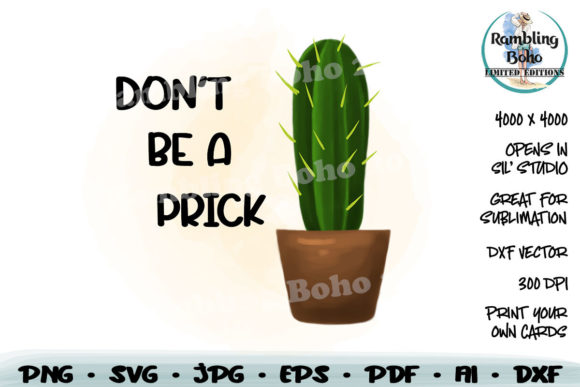
Before a single button is pressed on a heat press or a blade touches vinyl, the selection of the right digital file sets the trajectory for the entire project. The "Don't Be a..." cactus design is structured to support a multi-channel approach. In a professional workflow, relying on a single file format is a bottleneck. This asset bundle addresses that by providing a comprehensive suite of formats: PNG, JPG, SVG, EPS, PDF, AI, and DXF.
Effective planning begins with matching the file format to the intended output method. For sublimation projects involving mugs, towels, or t-shirts, the PNG format with a transparent background is the primary workhorse. At 4000px x 4000px and 300dpi, this resolution ensures that the rich colors and simple lines remain crisp even when scaled up to the maximum approximate size of 13″ x 13″. Using a lower resolution image for large-format sublimation often results in pixelation, which degrades brand perception. By starting with a high-DPI asset, you eliminate quality control issues before they arise.
Conversely, if your workflow involves cutting machines for iron-ons, stickers, or waterslides, the SVG format becomes central. SVG files are vector-based, meaning they can be opened in software like Silhouette Studio without losing fidelity. This allows for precise "print and cut" registration marks, ensuring that the cut line perfectly hugs the edge of the printed cactus design. The inclusion of a DXF file further expands compatibility for users operating laser machines or CAD-specific cutting environments, where non-color vector paths are required for accurate toolpath generation.
Integration into Diverse Production Pipelines
The true value of a digital design lies in its adaptability across different stages of production. The "Don't Be a..." cactus graphic demonstrates how a single creative concept can branch into multiple revenue streams or project types depending on how it is deployed.
Sublimation and Direct Printing
For sublimation enthusiasts and business owners, the process starts with color management. While the design boasts rich colors, screen settings and printing methods can cause slight variations. A prudent workflow includes printing a test tile on sublimation paper to verify color saturation and hue before committing to a full batch of blanks. This step is crucial for items like ceramic mugs or coated tumblers, where color shifts can be noticeable against white backgrounds.
Once the color profile is verified, the PNG file is imported into design software. Because the background is transparent, the designer can easily place the cactus graphic onto complex mockups or combine it with other text elements without tedious masking. This efficiency is vital for marketers and bloggers who need to generate social media visuals or product listings quickly. The JPG format included in the bundle serves as a fallback for platforms that do not support transparency, ensuring the asset remains usable even in restrictive content management systems.
Cutting and Vinyl Applications
When the workflow shifts from ink to blade, the SVG and DXF files take precedence. For creators making stickers or iron-on transfers, the vector nature of these files allows for infinite scalability. You can shrink the cactus for a small lapel sticker or enlarge it for a tote bag without worrying about jagged edges.
In Silhouette Studio, the SVG file enables the use of advanced features like offsetting, which creates a border around the design for easier weeding and application. This is particularly useful for small business owners producing handmade goods where presentation matters. The "flattened" nature of the EPS and AI formats preserves the integrity of the design elements, preventing accidental movement of layers during the export process to a cutter. This attention to file structure reduces errors and material waste, a key concern for productivity-minded users managing tight margins.
Optimizing Workflow Efficiency and Consistency
Integrating this type of asset into a routine requires organization. A common pitfall for freelancers and publishers is disorganized digital libraries, leading to time lost searching for the correct file version. To maintain efficiency, it is advisable to establish a folder structure that categorizes assets by project type (e.g., "Sublimation," "Cut Files," "Web Graphics").
Within this system, the "Don't Be a..." cactus bundle should be stored in its entirety. Having the PDF format available for quick proofing or client presentations adds another layer of utility. Clients can view the design in a universal reader without needing specialized graphic design software, streamlining the approval process. Furthermore, the editable yet flattened AI format offers a safety net for professional designers who may need to make minor adjustments within Adobe Illustrator while ensuring the core design remains intact.
Consistency is also maintained through the standardized dimensions of the source file. Knowing that the graphic is approximately 13″ x 13″ at 300dpi allows for immediate calculation of yield. For example, a standard 12″ x 12″ sheet of sublimation paper or vinyl can accommodate one large instance of the design or multiple smaller iterations. This predictability aids in inventory planning and cost estimation, allowing entrepreneurs to price their finished goods accurately.
Long-Term Usability and Adaptability
The lifecycle of a digital asset extends beyond the initial project. A high-quality design like the prickly cactus graphic can be repurposed months or even years later. As trends shift, the "Don't Be a..." sentiment remains evergreen, suitable for office decor, educational materials, or personal gifts. The versatility of the file formats ensures that as software updates or new machinery is acquired, the asset remains compatible.
For educators and content creators, these files can be used to teach design principles. The clear lines and distinct shapes make the SVG ideal for demonstrating vector manipulation, while the high-res PNG is perfect for lessons on raster graphics and resolution. This dual-purpose capability maximizes the return on investment for the download.
It is important to remember that while the digital file is robust, the physical outcome depends on the execution. Factors such as heat press temperature, pressure, and time for sublimation, or blade depth and speed for cutting, must be calibrated to the specific materials being used. The digital asset provides the blueprint, but the craftsman's skill determines the final quality. Regular maintenance of equipment and periodic recalibration ensure that the rich colors and sharp lines of the design translate faithfully to the physical product.
Final Thoughts on Implementation
Incorporating the "Don't Be a...." sublimation design into your workflow is a straightforward process that yields diverse results. By understanding the specific role of each file format—PNG for print, SVG/DXF for cut, and PDF/AI for editing and sharing—you can streamline your production pipeline. This approach minimizes errors, reduces waste, and accelerates time-to-market for your products.
Whether you are a small business owner launching a new collection of cactus-themed apparel or a hobbyist creating personalized gifts, the key lies in preparation. Download the complete bundle, organize your files, run your tests, and execute with precision. In a digital landscape saturated with mediocre assets, leveraging high-quality, versatile designs is a strategic advantage that supports sustainable growth and creative fulfillment.